easytraffic.biz

Buy website traffic, Get real targeted visitors.

Thursday, November 1, 2012

On This Week in History: Oct 29 - November 4

Oct 29, 1998 John Glenn returns to space

Back in Orbit: John Glenn's Return to Space
Nearly four decades after he became the first American to orbit the Earth, Senator John Hershel Glenn, Jr.,  is launched into space again as a payload specialist aboard the space shuttle Discovery. At 77 years of age, Glenn was the oldest human ever to travel in space. During the nine-day mission, he served as part of a  NASA study on health problems associated with aging.

Oct 30, 1938 Welles scares nation
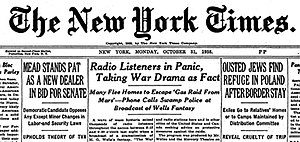
The New York Times headline from October 31, 1938
Orson Welles causes a nationwide panic with his broadcast of "War of the Worlds"—a realistic radio  dramatization of a Martian invasion of Earth. He was only 23 years old when his Mercury Theater company  decided to update H.G. Wells' 19th-century science fiction novel War of the Worlds for national radio. This  was not planned as a radio hoax, and Welles had little idea of the havoc it would cause.

The show began on Sunday, October 30, at 8 p.m. - prime-time in the golden age of radio with millions of  Americans tuned in. Welles introduced his radio play followed by a weather report. Then the scare began  with a report of explosions on the planet Mars followed by a large meteor crashed into Grovers Mills, New  Jersey. Soon, an announcer at the crash site described a Martian emerging from a large metallic cylinder,  Martians mounted walking war machines fired "heat-ray" weapons at humans and  annihilated 7,000 National Guardsman. The radio play was so realistic with sophisticated sound effects and actors portraying terrified announcers and other characters. As many as a million radio listeners believed that a real Martian invasion was underway. Panic broke out across the country. When news of the real-life panic leaked into the CBS studio, Welles went on the air as himself to remind listeners that it was just fiction.

The Federal Communications Commission investigated the program but found no law was broken. Welles feared that the controversy generated by "War of the Worlds" would ruin his career. In fact, the publicity  helped land him a contract with a Hollywood studio, and in 1941 he directed, wrote, produced, and starred  in Citizen Kane—a movie that many have called the greatest American film ever made.

Oct 31, 1517 Martin Luther posts 95 theses
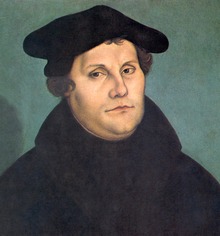
Luther in 1533 by Lucas Cranach the Elder
On this day in 1517, the priest and scholar Martin Luther approaches the door of the Castle Church in  Wittenberg, Germany, and nails a piece of paper to it containing the 95 revolutionary opinions that would  begin the Protestant Reformation. In his theses, Luther condemned the excesses and corruption of the Roman Catholic Church, especially the  papal practice of asking payment—called "indulgences"—for the forgiveness of sins.Though Prince Frederick III the Wise had banned the sale of indulgences in Wittenberg, many church members traveled to purchase them. When they returned, they showed the pardons they had bought to Luther, claiming they no longer had to repent for their sins.

The term "Protestant" first appeared in 1529, when Charles V revoked a provision that allowed the ruler of each German state to choose whether they would enforce the Edict of Worms. A number of princes and other supporters of Luther issued a protest, declaring that their allegiance to God trumped their allegiance to the emperor. They became known to their opponents as Protestants which gradually came to apply to all who believed the Church should be reformed, even outside Germany. By the time Luther died in 1546, his revolutionary beliefs had formed the basis for the Protestant Reformation, which would over the next three centuries revolutionize Western civilization.

Nov 01, 1512 Sistine Chapel ceiling opens to public

Inside the Sistine Chapel, looking west to the entrance. Photo © Web Gallery of Art.
The ceiling of the Sistine Chapel in Rome, one of Italian artist Michelangelo's finest works, is exhibited to the public for the first time. Michelangelo Buonarroti was the greatest of the Italian Renaissance artists. He was called to Rome in 1508 to paint the ceiling of the Sistine Chapel—the chief consecrated space in the Vatican. Michelangelo's epic ceiling frescoes, which took several years to complete, are among his most memorable works. Central in a 
complex system of decoration featuring numerous figures are nine panels devoted to biblical world history. The most famous of these is The Creation of Adam, a painting in which the arms of God and Adam are stretching toward each other. In 1512, Michelangelo completed the work. Michelangelo worked until his death in 1564 at the age of 88.

Nov 02, 1947 Spruce Goose flies

The Hughes Flying Boat—the largest aircraft ever built—is piloted by designer Howard Hughes on its first  and only flight. With laminated birch and spruce, the massive wooden aircraft had a wingspan longer than a football field and designed to carry more than 700 men.
Following the U.S. entrance into World War II in 1941, the U.S. government commissioned Hughes Aircraft  Company to build a large flying boat capable of carrying men and materials over long distances. Because of wartime restrictions on steel, Hughes decided to build his aircraft out of wood laminated with plastic and covered with fabric. Although it was constructed mainly of birch, the use of spruce would later earn the aircraft the nickname Spruce Goose. It had a wingspan of 320 feet and was powered by eight giant propeller engines. Development cost a phenomenal $23 million and took so long that the war had ended by the time of  its completion in 1946. With many detractors from Congress demanding that Hughes prove the plane airworthy, Hughes took  the H-4 prototype out into Long Beach Harbor, CA for an unannounced flight test November 2, 1947, Thousands of onlookers had come to watch the aircraft taxi on the water and were surprised when Hughes lifted his wooden behemoth 70 feet above the water and flew for a mile before landing.
The Spruce Goose never went into production, primarily because critics alleged that its wooden framework was insufficient to support its weight during long flights. Nevertheless, Howard Hughes refused to neglect his greatest achievement in the aviation field as he kept from 1947 until his death in 1976, the Spruce Goose  prototype ready for flight in an enormous, climate-controlled hangar at a cost of $1 million per year. Today, the Spruce Goose is housed at the Evergreen Aviation Museum in McMinnville, Oregon.


Nov 03, 1964 D.C. residents cast first presidential votes
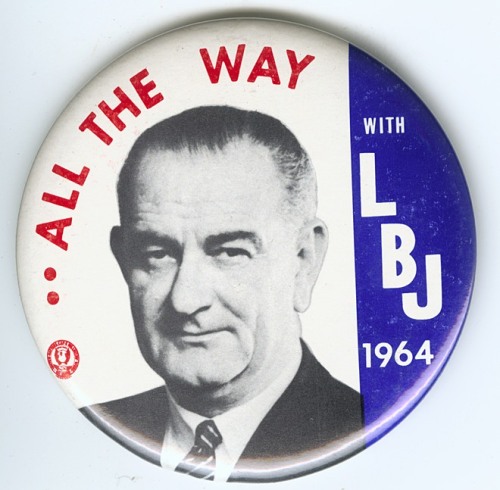
The first election that D.C. voters cast their ballots in was between incumbent President
Johnson and challenger Barry Goldwater.  D.C. voters helped secure LBJ’s presidential win 47 years ago
On this day in 1964, residents of the District of Columbia cast their ballots in a presidential election for the first time. The passage of the 23rd Amendment in 1961 gave citizens of the nation's capital the right to vote for a commander in chief and vice president. They went on to help Democrat Lyndon Johnson defeat Republican Barry Goldwater in 1964, the next presidential election.

In 1801, the District was put under the jurisdiction of Congress which terminated D.C. residents' voting  rights. In 1961, the 23rd Amendment restored these rights, allowing D.C. voters to choose electors for the  Electoral College based on population, with a maximum of as many electors as the least populated state. With a current population of over 550,000 residents, 61-square-mile D.C. has three electoral votes.


Nov 04, 1956 Soviets put brutal end to Hungarian revolution


A spontaneous national uprising that began 12 days before in Hungary is viciously crushed by Soviet tanks  and troops on this day in 1956. Thousands were killed and wounded and nearly a quarter-million Hungarians fled the country.
The problems in Hungary began in October 1956, when thousands of protesters took to the streets demanding a more democratic political system and freedom from Soviet oppression.  In response,  Imre Nagy, the newpremier,  tried
to restore peace and asked the Soviets to withdraw their troops. The Soviets did so, but Nagy then tried to push the Hungarian revolt forward by abolishing one-party rule and  announced that Hungary was withdrawing from the Warsaw Pact (the Soviet bloc's equivalent of NATO). On November 4, 1956, Soviet tanks rolled into Budapest to crush, once and for all, the national uprising.  Vicious street fighting broke out, but the Soviets' great power ensured victory. At 5:20 a.m., Nagy sought  asylum at the Yugoslav Embassy in Budapest. He was captured shortly thereafter and executed two years  later.
The Soviet action stunned many people in the West. An estimated 2,500 Hungarians died and 200,000 more fled as refugees. Sporadic armed resistance, strikes and mass arrests continued for months thereafter,  causing substantial economic disruption. Inaction on the part of the United States angered and frustrated  many Hungarians.  As Soviet tanks bore down on the protesters, theUnited States did nothing beyond issuing public statements of sympathy for their plight.


Tuesday, October 30, 2012

Popular Myths About Video Games

Below are the most common myths about video games from 10 Myths About Video Games by  and 

1: Video Games Are For Kids

from eessfkntu.blogfa.com
While it is true that kids love video games there are many, many more gamers now adults who grew up playing older games like"Mario Bros.", "Sonic the Hedgehog" or even games on the Atari -- and still love video games. This group practically  grew up with the video game industry with the latter now offering more sophisticated and violent games to keep up and support the changing tastes of this demographic.
In 2011, 53 percent of gamers fell within the 18 to 49 age range and the average gamer within that range  was 37. Gamers 50 and older now represent 29 percent of the market . Only 18 percent of gamers are under the age of 18, according to the Entertainment Software Association [ESA]. There are plenty of games still out there for kids, but the average gamer has definitely grown up.

2: Video Games Lead to Social Isolation

from destructoid.com
The usual Video gamer stereotype of nerdy indoor hobby gamers, sitting in their rooms or their mothers' basements staring at the TV day in and day out, never going outside to socialize with their peers, etc. is no more. Though accurate for some gamers, the anti-social stigma of video gaming fans has never been less true. Thanks to high speed Internet connectivity, gamers can play with one another from across the globe. More and more games are designed with cooperative play or competitive multiplayer in mind; time spent playing games often means time spent socializing. While competitive gaming also brings out a lot of trash talk in online communities, online play gives gamers the opportunity to spend time with distant friends or make new ones.

3: Video Games Lead to Violence.

from gadgetaccess.com
When youths engage in violent behavior, the brutal video games they played before they committed their crimes are generally cited as reasons for their tendencies. Logic simply follows:Violent video games make kids violent.
This idea remains conventional wisdom, although some studies of kids and aggressive video games have turned up evidence to the contrary. One 2005 study of people ages 14 to 68 who were asked to play 56 hours of the massively multi-player role playing game (MMRPG) "Asheron's Call 2" in one month found no noticeable change in aggressive behavior among players after the game. Nor did the researchers turn up an increase in aggression among gamers when compared to the control group who didn't play [source: PhysOrg].
Furthermore some more real life and crime statistics belie this notion. While video games continue to sell -- sales rose from $5.5 billion to $9.5 billion from 1999 to 2007 -- violent crime among youth actually declined. In 1999, 1,763 people under age 18 were arrested for homicides in the U.S.; in 2007, that age group accounted for 1,063 murders there [source: Safe Youth, FBI].

4: Girls Don't Play Video Games

Public perception of video games as an almost-strictly boys' pastime still remains; the relative lack of popularity of even the most obvious effeminate titles supports this notion. But does the fact that "Metal Gear Solid" vastly outsells Barbie titles on PlayStation mean that girls just don't play video games? Absolutely not.
In fact, from January to August 2008, females ages 18 to 45 came in second only to males of the same age group as the biggest spenders in video game industry (37 percent versus 38 percent) [source: Lee].

5: Pong Was the First Video Game

An upright cabinet of Pong
The common conception that "Pong" was the world's first video game is actually a myth.
Actually, another arcade game had been released a full year prior to "Pong"'s debut at Sunnyvale, Calif.'s Andy Capp's Tavern on Nov. 29, 1972 [source: BartonandLoguidice]. Contrary to popular belief, it turns out that the relatively little-known "Computer Space" holds the title of world's first arcade video game [source: Barton and Loguidice]. It was based on a computer game called "Spacewar!" that was a bit too difficult for gamers since, at that time, every gamer was a novice. "Pong" was slightly more everyone's speed; its popularity blew the doors off of "Computer Space" and led to the myth that it was the first video game.

Tags: , , , , , , , , , , , , , , , , , , Asheron's Call 2, , , , , , , , , , ,

Wednesday, October 24, 2012

Famous FAILED Doomsday Prophecies- FAILS then... HITs?

Below are the top 5 failed doomsday prophecy predictions of all time from smashinglists.com. Curiously, the Top 2 Doomsday failures are very much major parts of the history of 2 famous religious movements  today- well..not total failures after all...


5. Y2K Bug


In 2000, a there was a prediction that the Internet would crash and the entire world would fail to operate effectively with predictions of planes crashing, grocery stores being emptied, and bank accounts being drained. Because of this, many people believed that the turn of the new millennium would spell the end for the world as we know it. And on the morning of January 1st, 2001, people quickly realized that the prediction was false and went back to living their lives as normal.

4. Late Great Planet Earth 1970

The Late Great Planet Earth in the 1970′s provided a dispensationalist
view of the establishment being a key component of the return of Christ 
This was a a bestseller book in 1970 written by Hal Lindsey which claimed Christ’s magnificent return  within the 80s- NO specific year.  and his reputation as a writer suffered mildly with the passing of the 80s without incident but he was able to go as far as to acquire his own cable TV show which speaks about the same thing.

3. Heaven’s Gate 1997

from harunyahya.com
On March 26, 1997, a mass suicide was discovered in San Diego by the police composed of 39 people individuals all wearing the same thing. The group known as “Heaven’s Gate” were part of a cult who believed that their only chance at salvation was to kill themselves which they wanted to do before the world broke out in mass destruction and famine. 

2. The Great Disappointment 1844

On October 22, 1844, the Millerite believers, lead by William Miller, awaited the second coming of Christ. When he did not come on that day, they were greatly disappointed.
William Miller believed that the world would end on October 22nd, 1844 as this would be the day that Jesus would return and save all of those souls who were willing to accept his love guided which he deduced by doing a series of complex calculations. After his false predictions, he was never really seen or heard from much. His “Great Disappointment” proved to be too much for him and he lived the rest of his years in recluse and isolation. Out of this disappointment, however, the Seventh-day Adventist movement was born.

1. Jehovah’s Witnesses (Several Dates)

Charles Taze Russell the founder of The Jehovah Witnesses
Few can argue that the Jehovah’s Witnesses have claimed false doomsday predictions for a long time now. The group itself was discovered in 1874 by a man named Charles Taze Russell. After their inception, they had “predicted” several dates in which the world would end. These dates included 1874, 1914, 1918, 1920, 1925, 1941, and 1975.

Tags: , , , , , , , , , , , , , , ,

Tuesday, October 23, 2012

Funniest Tweets: Final 2012 Presidential Debate


The following are selected Funniest Tweets on the final 212 Presidential Debate between President Barrack Obama and Mitt Romney from a cnn.com  and ibtimes.com articles:

PeterLandau -- Our presidential candidates should be doping. This debate would be greatly improved by performance-enhancing drugs.
from someecards.com
wheezywaiter -- This split screen is making it easy to imagine a Romney/Obama Siamese twin.

W. Kamau Bell -- President Obama has that "I have Bin Laden's head in a bag beneath the desk." look in his eyes. #mockthevote #debate
from thescottcarpdream.blogspot.com

Donald J. Trump -- Stop congratulating Obama for killing Bin Laden. The Navy Seals killed Bin Laden. #debate

Scary Beans ‏-- Stop congratulating The Navy Seals for killing Bin Laden. Some guns and also some bullets killed Bin Laden. #debate

Andy Borowitz -- Both candidates' use of the numbers 1 through 5 underscores the importance of keeping Sesame Street. #debate
from worldmeets.us
jamisonfoser -- Obama: "I know you haven't had a chance to execute foreign policy." FACT-CHECK: Romney organized multinational Luge competition.

Arianna Huffington ‏-- So no daylight at all btw the two on drones and Afghanistan. This is more of a meeting than a debate.
Matthew Reichbach -- Obama should have picked up a mic and dropped it after that #horsesandbayonets line.
azizansari -- "What are you guys going to be for Halloween?" #BetterDebateQuestions
Romney and Obama masks at the Halloween Adventure store. (Photo by David Crane/Staff Photographer)

nickgillespie -- Governor, you get a phone call that Candy Crowley is on her way to moderate a debate. What do YOU do?
Some Dude -- Did we get married to Pakistan during a drunken weekend in Vegas?? Was Zach Galifianakas involved? #debates
kumailn -- To divorce Pakistan, you'd just have to say "divorce" three times. #islamjoke #lookitup #debate
anamariecox -- I went on an apology tour once and I was sorry I did.
Matt Binder -- "Don't say Obama Bin Laden." - Bob Schieffer preparing for the debate "Obama Bin Laden" - Bob Schieffer at the debate #debates

Monday, October 22, 2012

On This Week in History: Oct 22 - Oct 28

summarized from history.com

Oct 22, 1962 Cuban Missile Crisis.

from historyplace.com
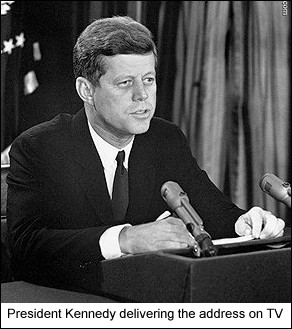
In a televised speech, President John F. Kennedy announces that U.S. spy planes discovered Soviet missile bases in Cuba which he called a "clandestine, reckless, and provocative threat to world peace." These sites nearing completion housed medium-range missiles capable of striking major cities in the United States, including Washington, D.C. He announced that he was ordering a naval "quarantine" of Cuba to prevent Soviet ships from transporting weapons to the island , that the US would not tolerate the existence of the site and made it clear that America would not stop short of military action to end what was then termed as the Cuban Missile Crisis.
reconnaissance photographs revealed Soviet missiles under construction in Cuba
The Crisis began October 15, 1962 when U.S. intelligence discovered Soviets building medium-range missile sites in Cuba. The next day, President Kennedy convened his ExCom (Executive Committee) meeting of senior military, political, and diplomatic advisers which decided to reject a surgical air strike against the missile sites but agreed on a naval quarantine and a demand that the bases be dismantled and missiles removed.  This decision was announced on national television on the night of October 22. During the next six days, the crisis escalated to a breaking point as the world tottered on the brink of nuclear war between the two superpowers where at one point, the U.S. military forces went to DEFCON 2-the highest military alert ever reached in the postwar era, as military commanders prepared for full-scale war with the Soviets. The ExCom even considered authorizing a U.S. invasion of Cuba countered the same day by Soviet leader Nikita Khrushchev with a proposal to end the crisis- the missile bases would be removed in exchange initially only for a U.S. pledge not to invade Cuba upped the next day by Khrushchev publicly calling for the dismantling of U.S. missile bases in Turkey.  To defuse the worsening crisis, Kennedy agreed to dismantle the U.S. missile sites in Turkey at a later date.
On October 28, Khrushchev announced his government's intent to dismantle and remove all offensive Soviet weapons in Cuba with implementation beginning that afternoon- effectively ending  The Cuban Missile Crisis. In November, Kennedy called off the blockade, and by the end of the year all the offensive missiles had left Cuba. Soon after, the United States quietly removed its missiles from Turkey.

Oct 23, 2002 Hostage crisis in Moscow Theater

Moscow Theater Siege
On October 23, 2002, about 50 Chechen rebels storm a Moscow theater (Moscow Ball-Bearing Plant's Palace of Culture), holding  700 people hostage during a sold-out performance of a popular musical "Nord Ost”. The terrorists identified themselves as members of the Chechen Army and had one demand- that Russian military forces begin an immediate and complete withdrawal from Chechnya, the war-torn region located north of the Caucasus Mountains occupied by Russian forces after Russian authorities blamed Chechens for a series of bombings in Russia.
After a 57-hour-standoff, on the morning of October 26,  Russian Special Forces pumped a powerful narcotic gas into the building, knocking nearly all of the terrorists and hostages unconscious then surrounded and raided the theater by breaking into the walls and roof entering through underground sewage tunnels.  Most of the guerrillas and 120 hostages were killed during the raid. Security forces later defended  the decision to use the dangerous gas, saying that only a complete surprise attack could have disarmed the terrorists before they had time to detonate their explosives.  After the theater crisis, President Vladimir Putin clamped down even harder on Chechnya. In response, Chechen rebels continued their terrorist attacks on Russian soil.

Oct 24, 1901 First barrel ride down Niagara Falls

Queen of the Mist
On this day in 1901, a 63-year-old school teacher Annie Edson Taylor becomes the first person to take the plunge over Niagara Falls in a barrel. In July 1901, the New York-born Taylor read about the Pan-American Exposition in Buffalo and the growing popularity of two enormous waterfalls located on the border of upstate New York and Canada. Strapped for cash and seeking fame, Taylor came up with the perfect attention-getting stunt- going over Niagara Falls in a barrel. She took the ride on her birthday, October 24. (at age 40- but records later showed she was 63.) She was strapped into a leather harness inside an old wooden pickle barrel five feet high and three feet in diameter with cushions lining the barrel to break her fall. Taylor was towed by a small boat into the middle of the fast-flowing Niagara River and cut loose.
Knocked violently from side to side by the rapids and then propelled over the edge of Horseshoe Falls, Taylor reached the shore alive but battered, around 20 minutes after her journey began. After a brief flurry of photo-ops and speaking engagements, Taylor's fame cooled, and she was unable to make the fortune for which she had hoped. She did, however, inspire a number of copy-cat daredevils between 1901 and 1995 where 15 people went over the falls 10 of them survived. No matter the method, going over Niagara Falls is illegal, and survivors face charges and stiff fines on either side of the border. 

Oct 25, 1881 Pablo Picasso born

Pablo Picasso
On this day in 1881 Pablo Picasso was born on this day at Malaga, Spain- one of the greatest and most influential artists of the 20th century.
Picasso had his first exhibit at age 13 and later quit art school so he could experiment full-time with modern art styles. He went to Paris for the first time in 1900, and in 1901 was given an exhibition at a gallery on Paris' rue Lafitte. His work, which comprises more than 50,000 paintings, drawings, engravings, sculptures, and ceramics produced over 80 years, is described in a series of overlapping periods. His first notable period--the "blue period"—he painted in blue tones to evoke the melancholy world of the poor (ex The Old Guitarist). This was followed by the "rose period," which depicted circus scenes and by his early work in sculpture. In 1907, he painted the groundbreaking work Les Demoiselles d'Avignon, 
Les Demoiselles d'Avignon (The Young Ladies of Avignon)
with its fragmented and distorted representation of the human form and is seen as a forerunner of the Cubist movement in 1909 which established the modern principle that artwork need not represent reality to have artistic value. After Cubism, Picasso explored classical and Mediterranean themes, and images of violence and anguish increasingly appeared in his work (example Guernica). His work after World War II is less studied than his earlier creations but he continued to work feverishly and enjoyed commercial and critical success. Known for his intense gaze and domineering personality, he had a series of intense and overlapping love affairs in his lifetime. He continued to produce art until his death in 1973 at the age of 91.

Oct 26, 1881 Shootout at the OK Corral


On this day in 1881, the Earp brothers face off against the Clanton-McLaury gang in a legendary shootout at the OK Corral in Tombstone, Arizona which was one of the richest silver mining towns in the Southwest. Wyatt Earp, a former Kansas police officer working as a bank security guard, and his brothers, Morgan and Virgil, the town marshal, represented "law and order" in Tombstone. The Clantons and McLaurys were cowboys who lived on a ranch outside of town and sidelined as cattle rustlers, thieves and murderers. In October 1881, the struggle between these two groups for control of Tombstone and Cochise County ended in a blaze of gunfire at the OK Corral between the Earp brothers and their friend Doc Holliday on one side AND the Clanton-McLaury gang on the other. When the dust cleared, Billy Clanton and the McLaury brothers were dead and Virgil and Morgan Earp and Doc Holliday were wounded. Ike Clanton and Claiborne had run for the hills.

Sheriff John Behan of Cochise County, who witnessed the shootout, charged the Earps and Holliday with murder. A month later, however, a Tombstone judge found the men not guilty, ruling that they were "fully justified in committing these homicides." The famous shootout has been immortalized in many movies.  

Oct 27, 1904 New York City subway opens

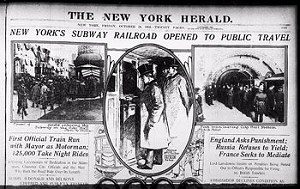
The New York Herald Headline

At 2:35 on the afternoon of October 27, 1904, New York City Mayor George McClellan takes the controls on the inaugural run of the city's innovative new rapid transit system: the subway.

While London boasts the world's oldest underground train network (opened in 1863) and Boston built the first subway in the United States in 1897, the New York City subway soon became the largest American system. The first line traveled 9.1 miles through 28 stations. Running from City Hall in lower Manhattan to Grand Central Terminal in midtown, and then heading west along 42nd Street to Times Square, the line finished by zipping north, all the way to 145th Street and Broadway in Harlem. 
The subway was opened to the general public at 7 p.m. that evening with more than 100,000 people paying a nickel each to take their first ride under Manhattan.  The service expanded to the Bronx in 1905, to Brooklyn in 1908 and to Queens in 1915. The system now  runs 24 hours a day, seven days a week;  has 26 lines and 468 stations in operation; the longest line, the 8th Avenue "A" Express train, stretches more than 32 miles, from the northern tip of Manhattan to the far southeast corner of Queens. Every day, some 4.5 million passengers take the subway in New York. 

Oct 28, 1965 Gateway Arch completed

The arch is it stands 630 feet (192 m) tall, and is 630 feet (192 m) wide at its base.
The cross-sections of its legs are equilateral triangles. Each wall consists of a stainless
steel skin covering reinforced concrete, with carbon steel and rebar from at the peak.
The interior of the Arch is hollow and contains a unique transport system leading to an observation deck at the top.

On this day in 1965, construction is completed on the Gateway Arch, a spectacular 630-foot-high parabola of stainless steel marking the Jefferson National Expansion Memorial on the waterfront of St. Louis, Missouri. The Arch, designed by Finnish-born, American-educated architect Eero Saarinen, was erected to commemorate President Thomas Jefferson's Louisiana Purchase of 1803 and to celebrate St. Louis' central role in the rapid westward expansion that followed.

 In 1947-48, Saarinen won a nationwide competition to design a monument honoring the spirit of the western pioneers. In a sad twist of fate, the architect died of a brain tumor in 1961 and did not live to see the construction of his now-famous arch, which began in February 1963. Completed in October 1965, the Gateway Arch cost less than $15 million to build. In addition to the Gateway Arch, the Jefferson Expansion Memorial includes the Museum of Westward Expansion and the Old Courthouse of St. Louis, where two of the famous Dred Scott slavery cases were heard in the 1860s. Today, some 4 million people visit the park each year to wander its nearly 100 acres, soak up some history and take in the breathtaking views from Saarinen's gleaming arch.


Tags: , , , , , , , , , , , , , , , , , , , , , , , , , , , , , , , ,